

Good horse camping can be wonderfully simple. Great horse camping usually comes down to preparation.
Most of us have had at least one trip where we forgot something important, underestimated the drive, or realized halfway through setting up camp that we should’ve practiced at home first. I’ve definitely been there myself. Usually those are the trips that teach us the most.
The good news is you don’t need expensive gear or a giant living quarters trailer to enjoy horse camping. You just need a little planning, safe horses, and realistic expectations about the kind of adventure you’re signing up for.
Good horse camping is easy. Great horse camping requires a little more preparation. Let’s discuss how to get the most out of your adventures — from what to look for in a campground, safe trailering to camp, and even why love letters are an important part of every camping trip!
Planning for a Horse Camping Adventure in the Front Country (or anywhere!)
First, do your homework. What type of adventure are you up for? In any camping environment, all you need is food, water, and shelter for horses and humans. Three things. That’s it. How complicated you make fulfilling those needs is up to you. You can keep it simple by heading to a fully equipped resort or you can decide to rule the wilderness.
There’s a world of difference between setting up camp at a guest ranch with reserved stalls and parking complete with water and electric hookups for your truck and trailer versus an outing that requires you to ride deep into a wilderness area with everything you need for survival on the back of your horse.
Types of horse camps include:
- Guest ranch, resort, or B&B – “glamping” with all the bells and whistles
- Established campgrounds – corrals are common, usually have restroom facilities, sometimes even shower houses such as at state parks, etc.
- Primitive camp – dispersed camping USFS/BLM areas
- Wilderness camping– packing in (we’ll visit that topic another time)
The amount of preparation depends on the type of camp you plan on visiting. Guest ranches take care of everything from corrals to dining facilities. Dispersed camping in a national forest means you’ll need to be proficient with not only horse containment but with water, shelter, and everything else you’ll need. It’s best to start slow and work up to more involved adventures.
With every trip, keep notes on what you forgot and what you brought but didn’t need. With each trip, you’ll become more organized and find out what little things helped you feel more comfortable in camp and on the trail. Using a printable checklist helps.
After you’ve decided what type of adventure you want, now is the time to start asking questions.
- What amenities are available? (Corrals, restrooms, showers, water.)
- What is the parking like? (Will my rig fit?)
- How are the trails? (Miles, difficulty, type.)
- Are reservations required? (Where do I make them?)
- Best times to visit?
- What are the rules and restrictions for the area? (Coggins test, brand inspection, health certificates, weed-free feed.) If certified weed-free feed is required, ask for a list of where to buy it.
- Are portable corrals allowed?
- Are dogs allowed?
- Fire and bear restrictions?
- Is it a multi-use area? Who will I meet on the trails and in camp?
- Driving distance and quality of the roads? How long will it take to get there, and can my truck and trailer make it?
Once you’ve settled on your destination, it’s time to start making sure that you and your horses are ready for the trip. It’s all good as long as nothing goes wrong. Are you preparing? Or you just surviving?
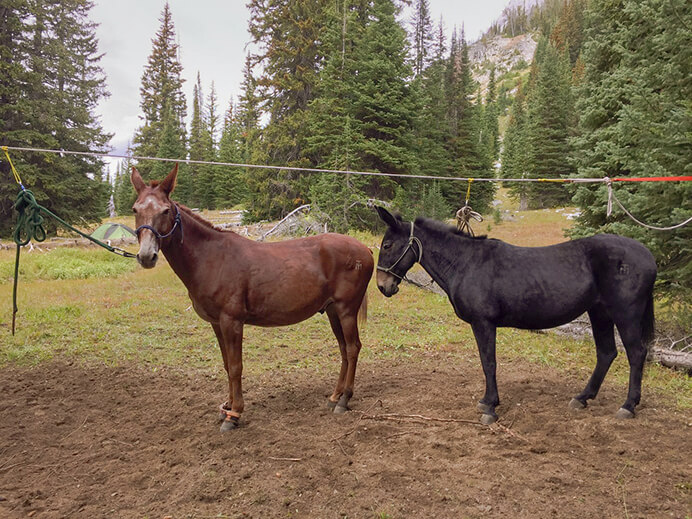
Food for Horses
The average equine eats about 2% of his body weight per day. If an average horse weighs 1,000 pounds that foots out to about 20 pounds of hay per horse per day. How are you going to carry it? By the way, pack your horse’s usual rations. You may be tempted to “treat” your horse to prepare him for a rigorous day of riding. Resist that urge. Keep your horse’s feed as close to normal as possible. Giving your horse foods that he’s not used to can cause digestive troubles.
If a specific type of feed (such as weed free) is required and it’s different from what you normally feed at home, you’ll want to change your horse’s diet gradually prior to your trip. For example, if changing from grain and hay to a complete pelleted feed or even from one kind of hay to another, do it well in advance so you don’t put your horse at risk of colic or other potential health problems.
Also, as much as they’ll want to, don’t allow horses to graze on green meadow grass if your horse is not accustomed to eating fresh forage at home. Colic is one thing you want to avoid especially when horse-camping, where the nearest veterinarian may be far away!
Water for Everyone
Dihydrogen monoxide. Water is the most vital of requirements for our animals as well as us. On average, horses drink 10 to 15 gallons of water a day. That’s a lot. Check in advance for availability of horse water. Inquire with the land manager or reputable online guide if water is available in a stream that flows all year long, or whether it’s supplied. Some streams are seasonal, and pumps can break, so plan a back-up.
There may be water for the horses, but is there potable water for you? If the H2O situation looks sketchy you’ll have to haul, and at 8.3 pounds per gallon, hauling sufficient water can quickly become a challenge.
Shelter/Containment
This is where things can get interesting. Much like toddlers our horses will get into mischief if allowed to wander unattended. A safe and secure method to keep them contained is imperative for a successful horse camping trip.
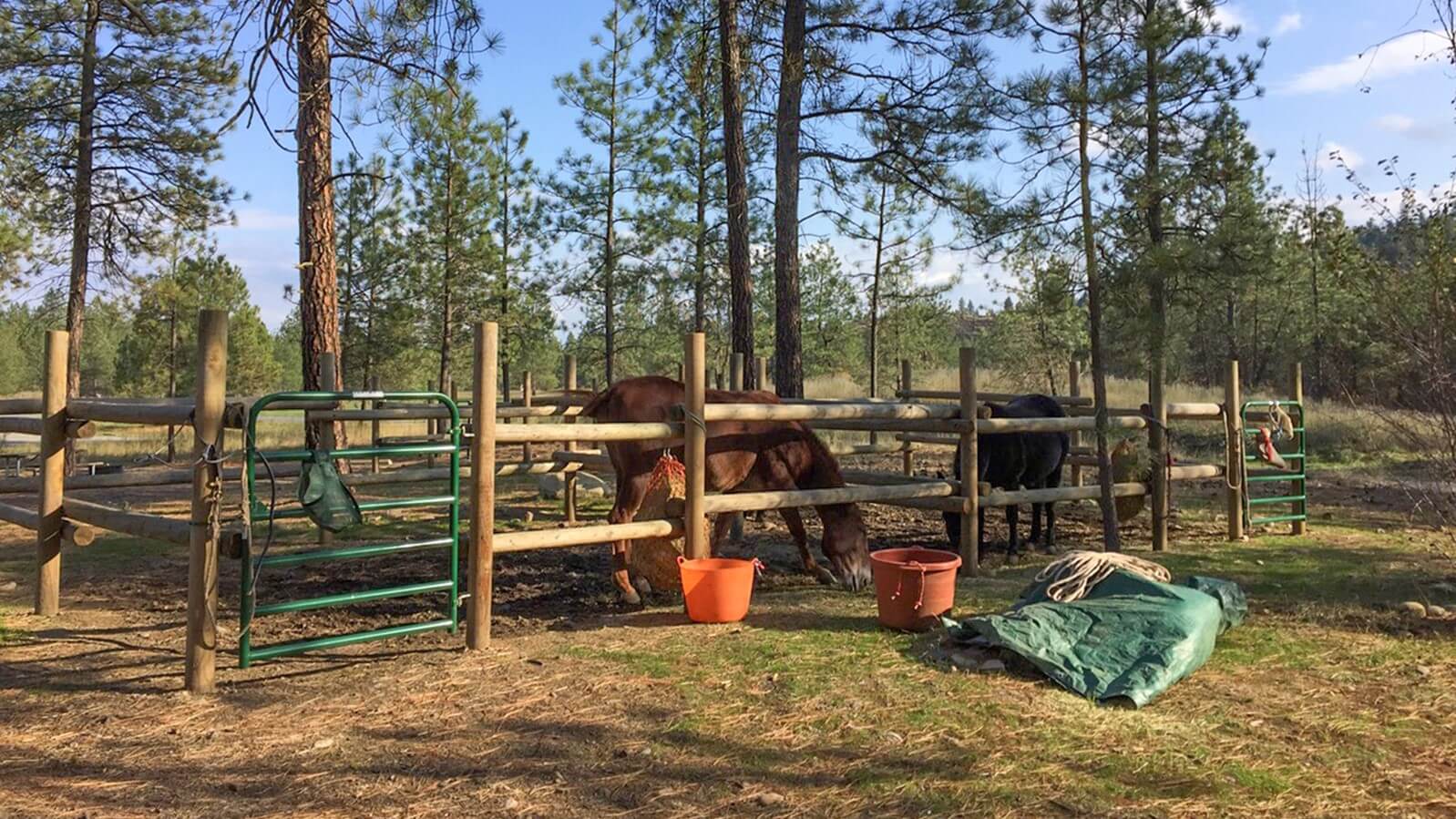
If you’re heading to a guest ranch or established horse camp with corrals, you shouldn’t have too many worries. Just to be safe it’s a good idea to take a few minutes and give the horse pen a good going-over before you put them in. And have an option in case the pens aren’t up to snuff.
For areas without corrals, you’ll need to examine various ways to hold your horses. Versatile, inexpensive, effective, and safe when properly set up, the highline is the gold standard for me. A good primer on how to set up a safe highline can be found here.
Another good equine containment option is portable corrals, either hard sided or electrical. Not all areas allow portable fencing so check with the land manager beforehand.
If you plan on using electric fencing be sure to get your animals used to it first at home. Animals unused to electric fence have a tendency to rush through rather than back away from the white line of electric. Also, remember that the natives (deer, elk, moose, bear) where you’ll be camping will not have had the benefit of such training.
Preparing for your Horse Camping Trip
Once you’ve handled the basic questions of where, when, why, and what, it’s time to start refining your skill sets to ensure that no matter what happens you’ll enjoy a worry-free outing. I start these preparations long before I load the trailer.
Priorities (in no particular order other than saving “love letters” for the end!)
Conditioning – Is your horse ready for long days on the trail? You’ll most likely be doing more riding than usual on your trip.
Vet checks – Is your horse medically fit for camping? Does he have all the required vaccinations? And the paperwork for them?
First aid skills (equine and human) – A good time for a primer on equine first aid is when the horse is getting his annual physical. Ask your vet to teach you how to check vitals such as pulse, temperature, and respiration. You’ll need to pass this information on to the veterinarian if there should be a problem at camp.
Communications – Most horse camps are far from reliable cell service. Do you have a way to communicate in an emergency?
Emergency plan – Have an outline of where you’re going, how long, who you’re going with, when you’re returning, and optionally any medical conditions you and your riding buddies have.
Take a trial run – My first camping trip of the year is always in my own backyard. I set up camp, put the horses on the highline, and try to recall how to get the Coleman stove running after eight months of inactivity. A practice camping trip at home is an excellent way to work the kinks out in a place where failure is an option.
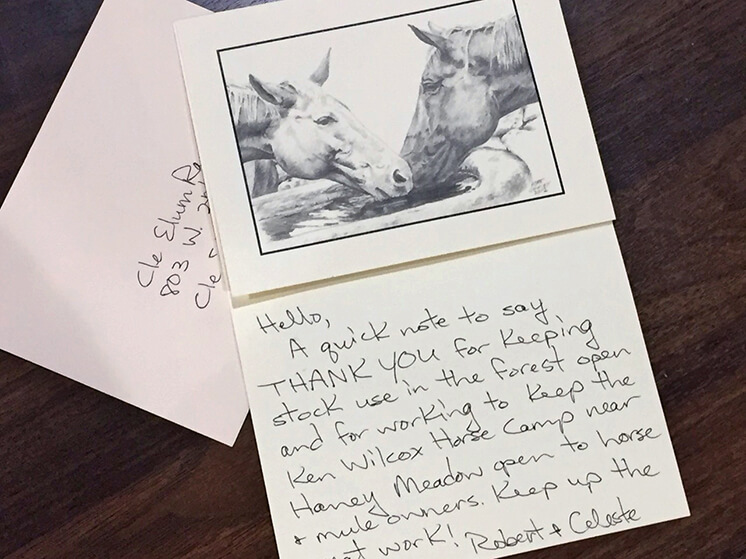
ove Letters – What do love notes have to do with trail riding and horse camping? Do the agencies that administer your riding areas know that horse owners are using the area? Without letting them know that equestrian activities are occurring they may forget when it comes to dedicating time, effort, and money into maintaining horse trails, equine parking, and horse camping areas.
I try to pen a quick note to the land manager of each area we ride or camp at so that they’re aware of the equine users in the places they are responsible for. These notes are not complaint posts but rather a thank you for making these trails open to stock use. In conversations with various recreation rangers from around the continent, they’ve heard a myriad of complaints but very few have received a thank you.
Positive reinforcement works. Or, as coined by Benjamin Franklin in his 1744 publication of Poor Richard’s Almanack, “Tart words make no friends: A spoonful of honey will catch more flies than a gallon of vinegar.” Send those love letters and postcards and help keep our trails open!
For more practical information on trail riding and horse camping, as well as the largest and most accurate guide to horse trails and camps, visit us at www.TrailMeister.com.
Originally published at https://nwhorsesource.com/front-country-horse-camping-what-to-know-before-you-go/
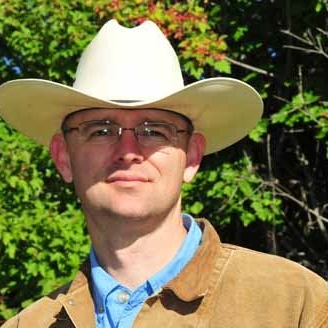
Robert Eversole, ”the trail meister,” owns www.TrailMeister.com, the largest database of horse riding and camping areas in the U.S. with free trail and trailhead information, trail maps, and much more to help horse enthusiasts experience the joys of trail riding. Robert is a registered riding instructor with PATH International, a mounted search and rescue team member, and a U.S. Marine who has served on the board of the Backcountry Horsemen of Washington (BCHW). He is enjoying his new career helping fellow trail riders stay found and safe on the trail. When not on the trail, The Trail Meister resides near Spokane, WA and teaches land navigation to a wide variety of outdoor groups across the nation. For North America’s largest horse trail and camping directory, trail tips, and more, visit www.TrailMeister.com.
