




A Horse’s Story Shines Light on Sun Safety
By Marjorielee Christianson for Virginia Polytechnic Institute and State University
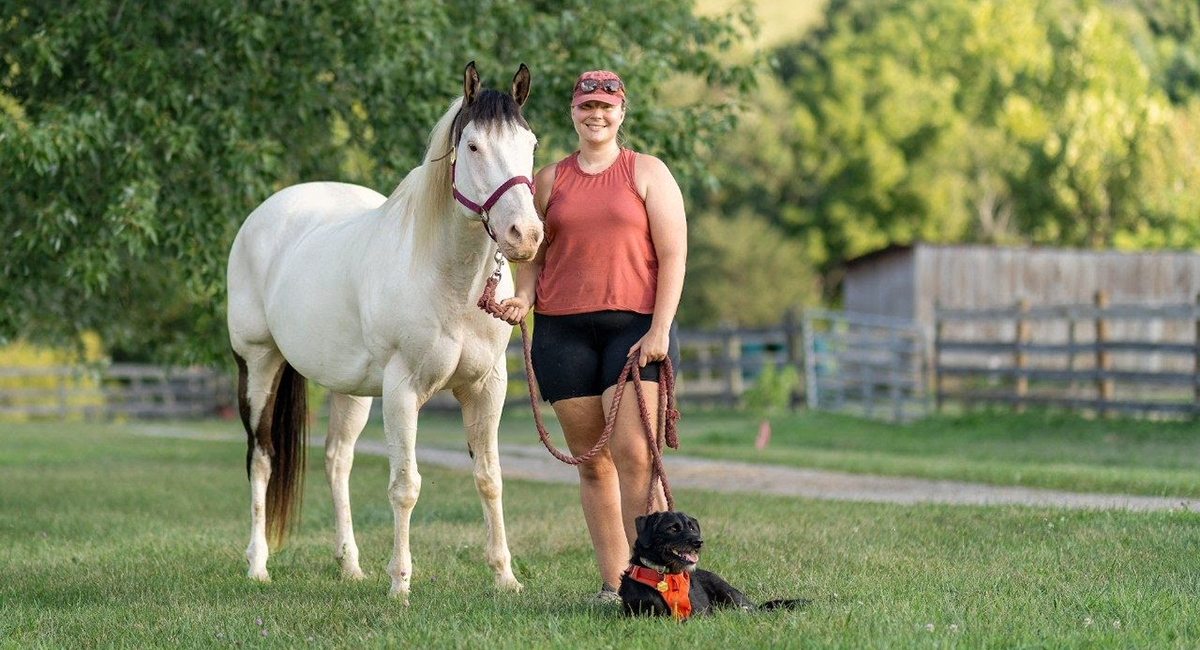
When Christie Goddard (2016 Virginia Tech grad) noticed fast-growing lumps on the eyelid of her 16-year-old American paint horse, Rowdy, she knew she needed to seek help.
The gelding, who had been part of her life since her time on the Virginia Tech equestrian team, was seen by the Equine Field Services team and then quickly referred to the Veterinary Teaching Hospital, where she was examined by Renata Ramos, clinical associate professor of ophthalmology.
The discovery confirmed an old adage: Too much of a good thing can be harmful, and in Rowdy’s case, that good thing was the sun. Dr. Ramos and her team quickly confirmed the diagnosis: squamous cell carcinoma, a common type of skin cancer in horses, especially those with low pigmentation around their eyes.
“This type of cancer rarely spreads to other parts of the body,” said Ramos. “But it can be locally invasive and is known to be aggressive in its recurrence.”
“I went in fully ready for him to have to lose his whole eye,” said Goddard. “So I was very scared, but the team at the teaching hospital was just so compassionate, kind, and reassuring.”
A Different Type of Light
Rowdy was a perfect candidate for a newer treatment, photodynamic therapy, which uses light to target and destroy remaining abnormal cells after surgery. Photodynamic therapy is not widely available, but it is becoming more popular because of its promising outcomes.
“Unfortunately, it’s a battle,” said Ramos. “I tell the students all the time that they have so many available treatments for this type of cancer because none of them work perfectly, but I think we are on the right track to find a better solution for these tumors.”
For Goddard, the procedure was a fast relief. “We dropped him off at 9 a.m. and he was home and back in a stall by 3 p.m. the same day,” she said. “He kept his whole eye, and he can see totally fine.”
“Rowdy was a star. He was a great patient,” said Ramos. “But also, how fast his owner decided to have this addressed is what made the difference.”
More than Fly Protection
Not all sun protection for horses is created equal, and Goddard said she hadn’t been aware of the differences in ultraviolet (UV) protection offered by fly masks.
“The standard fly masks you can buy…most of them are only 60 to 70 percent UV protection,” she said. A field horse like Rowdy, who lives outside 24/7, needs a much higher level of protection. Goddard now seeks out brands that provide 90 to 100 percent UV protection.
Key Takeaways for Horse Owners
All horses are susceptible to this common cancer, but horses with light-colored coats and low pigmentation around their eyes, noses, or other areas are at higher risk. This is especially true for breeds such as appaloosas, palominos, and American paint horses.
Ramos offered this advice for horse owners:
- Regularly check your horse for any unusual growths, lumps, or sores, especially around the eyes. Pay attention to any lesions that grow quickly or don’t heal.
- Make sure horses have access to shade in pastures to escape direct sun exposure.
- Use a high-quality fly mask that provides at least 90 percent UV protection. Standard fly masks often offer much less.
- Apply equine-safe sunscreen to pink skin around the nose and other areas that lack pigment.
For horses at higher risk, early detection is crucial: The quicker these issues are addressed, the better the outcome. If you notice anything concerning, contact your veterinarian immediately.
“As an ophthalmologist, I think all animals should have eye exams,” said Ramos. “But absolutely horses, not only for skin cancers, but also for uveitis, which is another common condition and one of the leading causes for blindness in these animals. So having the eyes checked once every year will be ideal.”
Read more from Marjorielee Christianson and Virginia Tech.
See this article in the October 2025 Online Digital Edition:
October 2025

The Northwest Horse Source is an independently owned and operated print and online magazine for horse owners and enthusiasts of all breeds and disciplines in the Pacific Northwest. Our contemporary editorial columns are predominantly written by experts in the region, covering the care, training, keeping and enjoyment of horses, with an eye to the specific concerns in our region.
