



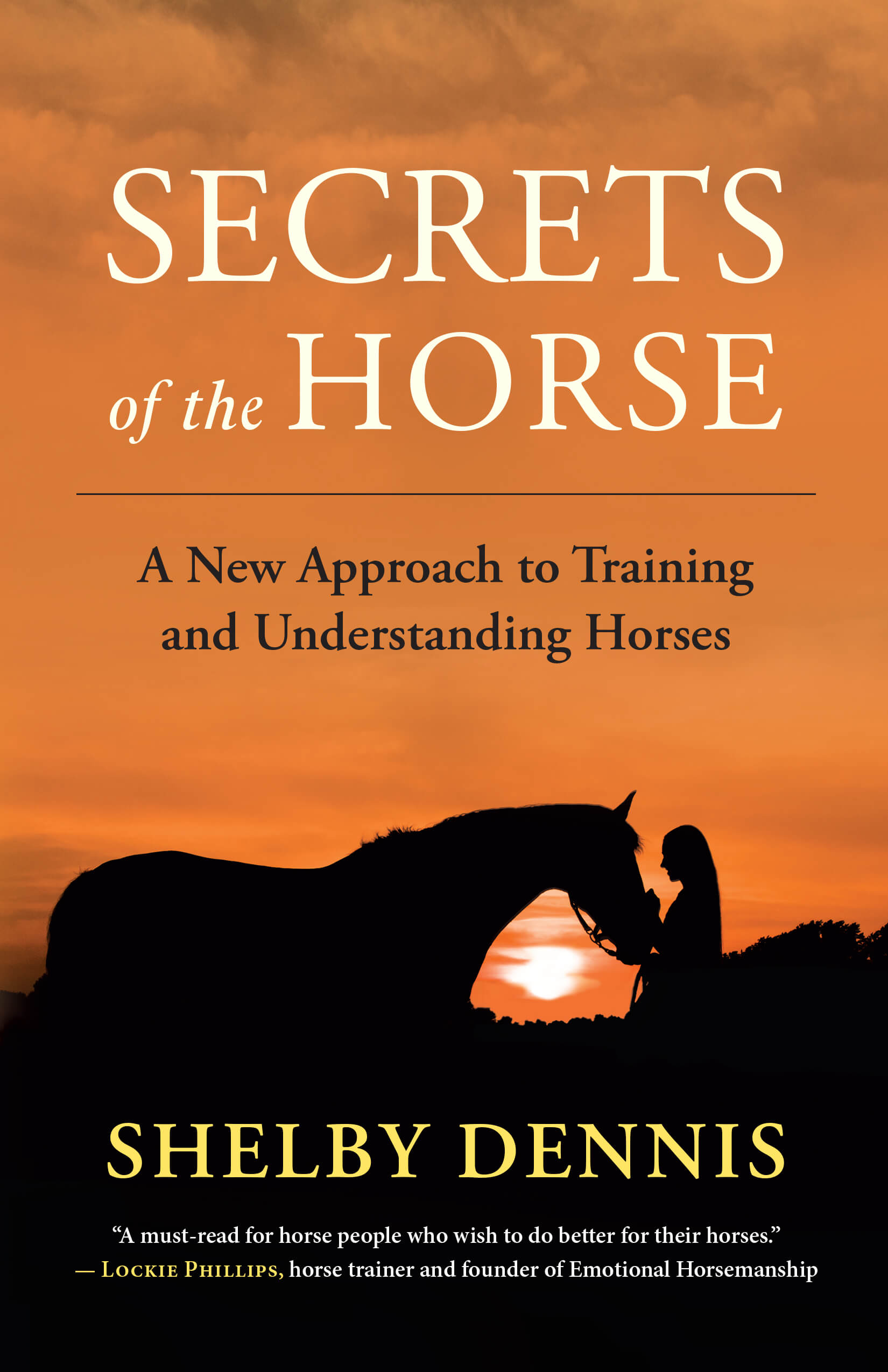
An excerpt from Secrets of the Horse, by Shelby Dennis
If you’ve been yearning for a better understanding of your horse, the answer lies in learning more about how horses function as a species and the science behind their behavior.
Developing more ethical training practices requires reflection on how the industry functions: how long-held beliefs came about in the first place, why they persist, and why horse training is often rooted in dominance. Reassessing beliefs about horse training may require the uncomfortable realization that misinformation about horse behavior, despite having been debunked by scientific research, is still spread rampantly. It may require a complete reset of how you perceive horses and the profoundly disquieting epiphany that stress in horses is far more prevalent than you may have thought, often being regarded as normal horse behavior.
For centuries, horses were used as work animals, playing a crucial role in helping us to construct civilizations with their incredible strength. Their history as animals used for labor undoubtedly plays a role in how we train and handle them. In times when horses were necessary for transportation and other tasks, there wasn’t room to consider their physical and emotional states. They weren’t even believed to be sentient animals. People didn’t spend much time pondering the emotional depth of horses, as the focus was on their usefulness to humans. The deployment of brute force wasn’t questioned, because it allowed people to force horses to get the job done.
Many of these outdated perspectives still influence how we handle horses. In today’s world, horses are largely leisure animals, kept for pleasure riding or for more structured competitive sports. But despite the dramatic shift in the use of horses over recent decades, humans have made little change in how we train them.
Archaic beliefs that horses are large, unintelligent, and potentially dangerous animals have such a strong grip that a horse’s size and power is often used to justify roughness in handling and training. People are told that they can’t let horses get away with “bad behavior” or it will escalate to something more dangerous. This creates a mindset that normalizes physical punishment, harsh handling, and use of aggressive equipment as a means of maintaining control. It promotes the notion that punishment-based training makes horses safer, despite the lack of evidence that this is true.
People still believe that dominance is a necessary part of horse handling, that they must show the horse who’s boss in order to achieve safety. Many believe that horses intentionally behave in a dangerous manner to assert dominance over their human handlers and that if this attempt at disrupting the horse-human power dynamic isn’t corrected, the horse will believe that they are the boss.
This mindset has no scientific merit. Modern research has allowed us to understand horse’s cognitive capacity in far greater depth. Recent studies have shown that behavioral problems are consistently associated with underlying stressors in training or management and stress and unmet needs significantly contribute to the danger horses pose to humans. We also have a better grasp of the social dynamics of free-roaming horse herds, giving more context to their fluid hierarchical structures and why conflict arises between horses — usually over resources and the perceived lack of them, not driven by dominance.
Yet even with this better understanding of the equine species, the industry is still saturated with misinformation, often pushing back against scientific research. Horses are flight animals which means that when they feel unsafe, their primary response is to flee. When humans see unwanted behaviors, most of the time it is a direct response to stress, which is then often misinterpreted as dominance. The truth is far from the case. Often all the horse was attempting to do was escape a perceived threat or communicate discomfort.
The dominance-centered perspective in horse training justifies unethical practices on the basis that horses not only know the difference between right and wrong, but will actively choose to do the wrong thing to be defiant. This outdated mindset disrupts our ability to find true harmony with horses, because it is committed to fundamentally misunderstanding them. It also encourages a human-versus-horse mentality, making the horse into an adversary and producing in the handler a certain level of frustration and anger that isn’t conducive to ethical training.
To achieve long-term stability in training and actively solve issues as they arise, we must try to understand horses on the basis of how they see the world, not on our projected human-centric notion of the horse. It is incredibly difficult to adequately address issues in training when we do not understand what is driving a behaviour or when we personalize behavior, believing that the horse is being deliberately defiant. Focusing on eradicating behaviours we find inconvenient — instead of pondering why the behavior exists in the first place — leaves no room to be considerate of the horse’s emotional state or their underlying motivations. Such mindsets negate any ability to unpack equine behavior and hinder our growth as horse people, blocking the path to true communication with horses.
Outside of the efficacy of a more horse-centric training approach, in order for people to work with horses in an ethical manner, it is crucial that we endeavor to better understand them and remove ego from the equation. Without doing so, we will always create an unfair power dynamic that disables the horse’s ability to truly communicate, silences their voice, and suppresses valuable information we could use to determine potential behavioral and soundness issues and where they stem from.
The idea of being partners with horses is commonplace in the industry; many equestrians will say that they have a partnership with their horse. But we must ask ourselves: Is this really true in practice? A partnership suggests that each side has a voice of equivalent importance. In horse-human relationships where physical punishment is involved, this cannot be the case. What this tells the horse is that their voice matters only when it is in alignment with human expectations. As soon as behavioral expression is inconveniencing the path to human goals, it is unacceptable. This dynamic more closely resembles a dictatorship.
It can be difficult when a horse behaves in ways that are disruptive to training, but even the “bad” behaviour is a crucial part of communication with horses. The perceived “bad” behaviors tell a valuable story that is necessary training information. By suppressing such behaviors, we are not addressing the underlying feelings that are being expressed. When the underlying cause of behaviour goes ignored, the problem is never addressed. It can lead horses to bottle up unpleasant feelings until they cannot cope and escalate to more dangerous reactions. They may also shutdown to dissociate from a world that is too stressful to cope with. This isn’t fair to ask of any animal, much less a highly emotive species like the horse.
The reality is that ethical training that values the horse as a sentient being is reliant on humans adjusting their training goals. It requires more accountability for how your actions and the equipment you use impact the horse. You cannot honor the welfare of an animal when your goals are incompatible with the horse’s current welfare state.
This level of sacrifice isn’t typically encouraged in the modern horse world: value is placed on the speed of acquiring new skills and far too little value on whether those skills were ethically acquired. The horse world has constructed a value system that rewards a trainer’s ability to produce over all else. The more animals a program can churn into winning show horses, the more successful that trainer becomes, even if the horses have become hollow husks of the dynamic beings they used to be. When priority is placed on how much you can make horses do rather than how much you honor them as animals, ethics are lost in the process. This capitalistic mindset views horses more as vehicles for achieving goals than as individuals, and it is incompatible with protecting the welfare of horses. What should be placed first and foremost is the horses’ emotional state during training.
I have good news, though! There are ways to teach horses an abundance of skills that do not rely on the horse being treated like a robot. We don’t have to choose between either training horses or valuing their welfare — these things can go hand in hand. It may just look different. Training can be mutually fun for horse and human, but it is reliant on learning to understand the horse’s communication (both good and bad), along with using reward to reinforce the horse’s participation. After centuries of relying on aversive pressure and force, we now know training alternatives that allow for more autonomous choice from the horse and encourage desired behaviors through reward, not discomfort.
Embrace the discomfort that comes with challenging the status quo and owning up to when you have erred. While this is hard to do initially, it is also exceptionally freeing and teaches us to realize, without shame, that making mistakes is part of the process. It is not the error that is the problem, but how we respond to it. With this malleable perspective, you can continue to implement changes for the benefit of your horse. Thinking critically and engaging in self-structured learning are invaluable skills when it comes to advocating for our horses in an industry where we may be encouraged to engage in unethical training. While learning more about horses is important, it is equally about developing a core sense of self and faith in your ability to create your own foundation for horse training that cannot be easily shaken by others.
# # #
Shelby Dennis is the author of The Secrets of the Horse: A New Approach to Training and Understanding Horses. She is an IAABC certified equine behavior consultant, horse trainer, and social media influencer popular among equestrians worldwide. She lives in British Columbia, Canada. Learn more at https://milestoneequestrian.ca.
Excerpted from the book The Secrets of the Horse Copyright© 2026 by Shelby Dennis. Reprinted with permission from New World Library. www.newworldlibrary.com

The Northwest Horse Source is an independently owned and operated print and online magazine for horse owners and enthusiasts of all breeds and disciplines in the Pacific Northwest. Our contemporary editorial columns are predominantly written by experts in the region, covering the care, training, keeping and enjoyment of horses, with an eye to the specific concerns in our region.
